
KENALI DAN IDENTIFIKASI FAKTOR RISIKO DIABETES MELITUS PADA DIRI SENDIRI: RENDAH, SEDANG ATAU TINGGI

Oleh: Eny Erlinda W
Prodi Keperawatan
Semua orang di dunia memiki resiko menderita Diabetes Melitus baik yang memiliki riwayat genetik keluarga ataupun tidak. Hal ini berkaitan dengan etiologi diabetes melitus yang telah diidentifikasi. Faktor seperti gaya hidup memberikan dampak langsung jangka panjang terhadap insiden diabetes melitus tipe 2 pada seseorang. Pemilihan berbagai produk dan alat dalam kehidupan sehari-hari, yang diketahui mengandung berbagai logam berat diketahui memiliki kontribusi terhadap peningkatan kasusu diabetes melitus. Oleh karena itu, peningkatan kasus diabetes melitus tidak hanya berkaitan dengan riwayat keturunan diabetes melitus.
Data penderita diabetes melitus di indonesia diketahui menduduki peringkat kelima dunia(Sun et al., 2023) dan dalam kawasan Western Pasifik, Indonesia berada di peringkat kedua terbanyak(WHO, 2016). Jumlah penderita diabetes melitus ini diperkirakan akan terus meningkat jika tidak dilakukan upaya pencegahan dan promosi kesehatan secara serius. Peningkatan jumlah penderita diabetes melitus akan memberikan dampak serius. Hal ini berkaitan dengan komplikasi jangka panjang yang ditimbulkan serta penurunan fungsi fisiologis bagi penderita yang muncul akibat penyakit(Choi, Kim and Song, 2022). Pada akhirnya secara makroekonomi akan mempengaruhi peningkatan biaya rawat, pengobatan dan penanganan tahap lanjut sebagai akibat perjalanan komplikasi penyakit diabetes melitus(Bernardo Nóbrega et al., 2019).
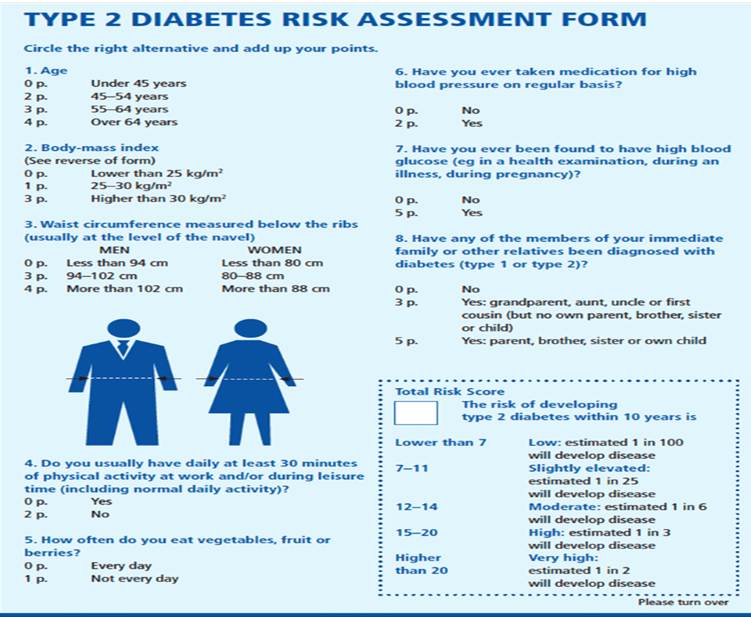
Berbagai upaya pencegahan yang dapat dilakukan adalah mengenali faktor risiko diabetes melitus secara dini melalui pemeriksaan skrining(Carmichael et al., 2021)(Salasa, Rahman and Andiani, 2019). Saat ini banyak instrumen sederhana seperti kuesioner sederhana yang telah dikembangkan sehingga dapat dimanfaatkan untuk mengetahui kelompok faktor risiko rendah, sedang dan tinggi. Hal semacam ini dapat digunakan secara langsung oleh orang dewasa untuk mengidentifikasi dirinya lalu mengenali faktor risiko yang dapat dicegah terhadap diabetes melitus.
Instrumen sederhana yang bisa digunakan misalnya kuesioner FINDRISC yang terdiri dari beberapa pertanyaan dengan skor pada tiap pertanyaan(Janghorbani, Adineh and Amini, 2013). Lalu pada akhir pertanyaan akan diakumulasi lalu dikategorikan menjadi rendah, sedang dan tinggi. Instrumen ini udah digunakan untuk membantu seseorang mengidentifikasi diri sendiri terhadap faktor-faktor yang berkaitan dengan diabetes melitus 2. Dengan demikian pada akhirnya seseorang dapat melakukan upaya pencegahan dan perbaikan pola atau gaya hidup(Salasa, Rahman and Andiani, 2019). Hal yang perlu dipahami misalnya perhitungan masa indeks tubuh, karena ini memerlukan pemahaman seseorang dalam menghitung berdsarkan tinggi dan berat badan.
Kuesioner ini tidak ditujukan untuk menegakkan diagnosis medis diabetes melitus. Penggunaan kuesioner ini dimaksudkan untuk mengenali risiko diri terhadap berbagai faktor yang diketahui berkaitan dengan penyebab diabetes melitus tipe 2. Bahkan dalam kuesioner ini, seseorang dengan pemahaman yang terbatas mengenai diabetes melitus dapat termotivasi untuk mencari tahu, mengenai diabetes melitus lalu kondisi dirinya saat ini bahkan sampai pada upaya untuk bertanya atau mencari tahu pada petugas kesehatan setempat. Hal inilah kemudian yang diharapkan sebagai langkah sederhana untuk menginisiasi seseorang untuk lebih peduli terhadap diri sendiri khususnya resiko diabetes melitus.
Upaya ini merupakan cara sederhana yang dapat digunakan dimulai dari individu dalam upaya promosi dan pencegahan terhadap diabetes melitus. Dengan menyadari beberapa faktor yang saat ini diketahui memiliki risiko terhadap kejadian diabetes melitus ( aktivitas fisik, BMI, kebiasaan konsumsi sayur/buah) maka diharapkan membuat seseorang untuk dapat mengontrol atau merubah faktor kebiasaan tersebut.
Referensi
Bernardo Nóbrega, L. M. et al. (2019) ‘Characteristics and Quality of Life of People With Diabetes.’, Journal of Nursing UFPE / Revista de Enfermagem UFPE, 13(5), pp. 1243–1252. Available at: https://search.ebscohost.com/login.aspx?direct=true&db=ccm&AN=136898006&%0Alang=es&site=ehost-live&scope=site.
Carmichael, J. et al. (2021) ‘Advances in Screening, Early Diagnosis and Accurate Staging of Diabetic Neuropathy’, Frontiers in Endocrinology, 12(May), pp. 1–25. doi: 10.3389/fendo.2021.671257.
Choi, J. H., Kim, H. R. and Song, K. H. (2022) ‘Musculoskeletal complications in patients with diabetes mellitus’, Korean Journal of Internal Medicine, 37(6), pp. 1099–1110. doi: 10.3904/kjim.2022.168.
Janghorbani, M., Adineh, H. and Amini, M. (2013) ‘Evaluation of the Finnish Diabetes Risk Score (FINDRISC) as a screening tool for the metabolic syndrome’, The review of diabetic studies?: RDS, 10(4), pp. 283–292. doi: 10.1900/RDS.2013.10.283.
Salasa, R. A., Rahman, H. and Andiani, A. (2019) ‘Faktor Risiko Diabetes Mellitus Tipe 2 Pada Populasi Asia: A systematic Review’, Jurnal Biosainstek, 1(01), pp. 95–107. doi: 10.52046/biosainstek.v1i01.306.
Sun, H. et al. (2023) ‘Erratum to “IDF Diabetes Atlas: Global, regional and country-level diabetes prevalence estimates for 2021 and projections for 2045” [Diabetes Res. Clin. Pract. 183 (2022) 109119] (Diabetes Research and Clinical Practice (2022) 183, (S0168822721004782), (1’, Diabetes Research and Clinical Practice, 204(October), p. 110945. doi: 10.1016/j.diabres.2023.110945.
WHO (2016) ‘Global Report on Diabetes’, Isbn, 978, pp. 6–86.
RECOGNIZE AND IDENTIFY YOUR RISK FACTOR’S FOR DIABETES MELLITUS: LOW, MODERATE, OR HIGH
By: Eny Erlinda W,
Nursing Department
Everyone in the world is at risk of suffering from Diabetes Mellitus, whether they have a family genetic history or not. This is related to the etiology of diabetes mellitus that has been identified. Factors such as lifestyle have a long-term direct impact on the incidence of type 2 diabetes mellitus in a person. The selection of various products and tools in daily life, which are known to contain various heavy metals is known to contribute to the increase in the incidence of diabetes mellitus. Therefore, the increase in diabetes mellitus cases is not only related to the hereditary history of diabetes mellitus.
Data on diabetes mellitus sufferers in Indonesia is known to rank fifth in the world (Sun et al., 2023) and in the Western Pacific region, Indonesia ranks second in the highest number (WHO, 2016). The number of diabetes mellitus sufferers is expected to continue to increase if serious prevention and health promotion efforts are not implemented. The increasing number of diabetes mellitus sufferers will have serious impacts. This is related to the long-term complications that arise and the decline in physiological function for sufferers that arise due to the disease (Choi, Kim and Song, 2022). Ultimately, macroeconomically, it will affect the increase in costs of care, treatment, and advanced management as a result of the course of complications of diabetes mellitus (Bernardo Nóbrega et al., 2019).
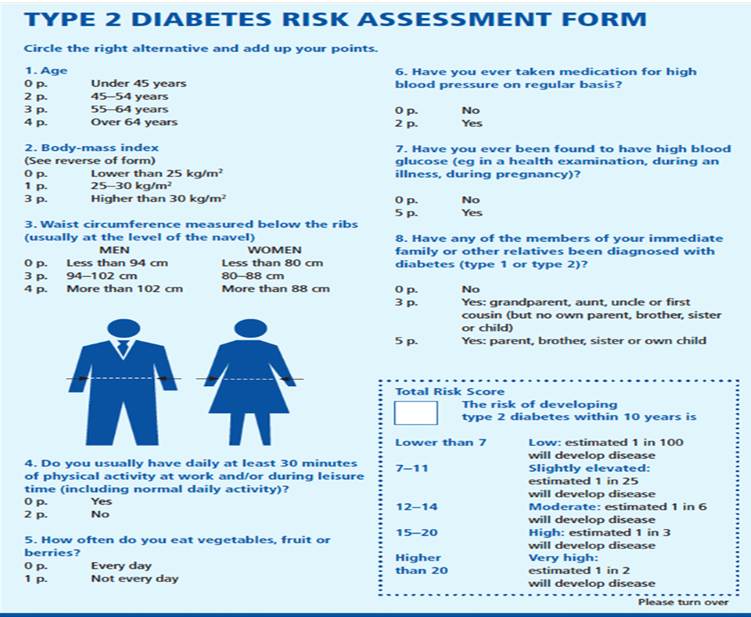
Various preventive efforts that can be carried out are to recognize risk factors for diabetes mellitus early through screening (Carmichael et al., 2021)(Salasa, Rahman and Andiani, 2019). Currently, many simple instruments such as simple questionnaires have been developed so that they can be used to determine groups of low, medium and high risk factors. This kind of thing can be used directly by adults to identify themselves and then recognize preventable risk factors for diabetes mellitus.
This questionnaire is not intended to establish a medical diagnosis of diabetes mellitus. The use of this questionnaire is intended to recognize the risk of self-harm to various factors known to be related to the cause of type 2 diabetes mellitus. Even in this questionnaire, a person with a limited understanding of diabetes mellitus can be motivated to find out, about diabetes mellitus and then his current condition even to the point of trying to ask or find out from the local health officer. This is then expected as a simple step to initiate someone to care more about themselves, especially the risk of diabetes mellitus.
A simple instrument that can be used is for example the FINDRISC questionnaire which consists of several questions with a score on each question (Janghorbani, Adineh and Amini, 2013). Then at the end of the questions will be accumulated and then categorized into low, medium and high. This instrument has been used to help a person identify themselves against factors related to diabetes mellitus 2. Thus, in the end, a person can make efforts to prevent and improve their lifestyle or pattern (Salasa, Rahman and Andiani, 2019). Things that need to be understood are for example the calculation of the body index period, because this requires a person's understanding in calculating based on height and weight.
This effort is a simple way that can be used starting from individuals in efforts to promote and prevent diabetes mellitus. By being aware of several factors that are currently known to have a risk of diabetes mellitus (physical activity, BMI, vegetable/fruit consumption habits), it is hoped that a person will be able to control or change these habit factors.
Reference
Bernardo Nóbrega, L. M. et al. (2019) ‘Characteristics and Quality of Life of People With Diabetes.’, Journal of Nursing UFPE / Revista de Enfermagem UFPE, 13(5), pp. 1243–1252. Available at: https://search.ebscohost.com/login.aspx?direct=true&db=ccm&AN=136898006&%0Alang=es&site=ehost-live&scope=site.
Carmichael, J. et al. (2021) ‘Advances in Screening, Early Diagnosis and Accurate Staging of Diabetic Neuropathy’, Frontiers in Endocrinology, 12(May), pp. 1–25. doi: 10.3389/fendo.2021.671257.
Choi, J. H., Kim, H. R. and Song, K. H. (2022) ‘Musculoskeletal complications in patients with diabetes mellitus’, Korean Journal of Internal Medicine, 37(6), pp. 1099–1110. doi: 10.3904/kjim.2022.168.
Janghorbani, M., Adineh, H. and Amini, M. (2013) ‘Evaluation of the Finnish Diabetes Risk Score (FINDRISC) as a screening tool for the metabolic syndrome’, The review of diabetic studies?: RDS, 10(4), pp. 283–292. doi: 10.1900/RDS.2013.10.283.
Salasa, R. A., Rahman, H. and Andiani, A. (2019) ‘Faktor Risiko Diabetes Mellitus Tipe 2 Pada Populasi Asia: A systematic Review’, Jurnal Biosainstek, 1(01), pp. 95–107. doi: 10.52046/biosainstek.v1i01.306.
Sun, H. et al. (2023) ‘Erratum to “IDF Diabetes Atlas: Global, regional and country-level diabetes prevalence estimates for 2021 and projections for 2045” [Diabetes Res. Clin. Pract. 183 (2022) 109119] (Diabetes Research and Clinical Practice (2022) 183, (S0168822721004782), (1’, Diabetes Research and Clinical Practice, 204(October), p. 110945. doi: 10.1016/j.diabres.2023.110945.
WHO (2016) ‘Global Report on Diabetes’, Isbn, 978, pp. 6–86.
Bernardo Nóbrega, L. M. et al. (2019) ‘Characteristics and Quality of Life of People With Diabetes.’, Journal of Nursing UFPE / Revista de Enfermagem UFPE, 13(5), pp. 1243–1252. Available at: https://search.ebscohost.com/login.aspx?direct=true&db=ccm&AN=136898006&%0Alang=es&site=ehost-live&scope=site.
Carmichael, J. et al. (2021) ‘Advances in Screening, Early Diagnosis and Accurate Staging of Diabetic Neuropathy’, Frontiers in Endocrinology, 12(May), pp. 1–25. doi: 10.3389/fendo.2021.671257.
Choi, J. H., Kim, H. R. and Song, K. H. (2022) ‘Musculoskeletal complications in patients with diabetes mellitus’, Korean Journal of Internal Medicine, 37(6), pp. 1099–1110. doi: 10.3904/kjim.2022.168.
Janghorbani, M., Adineh, H. and Amini, M. (2013) ‘Evaluation of the Finnish Diabetes Risk Score (FINDRISC) as a screening tool for the metabolic syndrome’, The review of diabetic studies?: RDS, 10(4), pp. 283–292. doi: 10.1900/RDS.2013.10.283.
Salasa, R. A., Rahman, H. and Andiani, A. (2019) ‘Faktor Risiko Diabetes Mellitus Tipe 2 Pada Populasi Asia: A systematic Review’, Jurnal Biosainstek, 1(01), pp. 95–107. doi: 10.52046/biosainstek.v1i01.306.
Sun, H. et al. (2023) ‘Erratum to “IDF Diabetes Atlas: Global, regional and country-level diabetes prevalence estimates for 2021 and projections for 2045” [Diabetes Res. Clin. Pract. 183 (2022) 109119] (Diabetes Research and Clinical Practice (2022) 183, (S0168822721004782), (1’, Diabetes Research and Clinical Practice, 204(October), p. 110945. doi: 10.1016/j.diabres.2023.110945.
WHO (2016) ‘Global Report on Diabetes’, Isbn, 978, pp. 6–86.